Yesterday afternoon and today, I've been busy optimizing the Menai compiler. Having worked on gcc for many years I knew I enjoyed doing this, but doing this with an AI assistant takes it to a whole new level!
Menai?
Yes, "Menai", in honour of the part of North Wales I lived in for a while where I could see the Menai Straits and where my favourite bit of civil engineering is: The Menai Bridge. Menai is much easier to say than "AIFPL" and I rather like that it ends with "ai" :-)
Adding a "None" type
One of the more interesting quirks of programming languages is knowing what to call "nothing at all". Up until now, I'd been using #f to signal that there was no result from a function call (e.g. it didn't find anything useful), but it turns out that's a problem if the actual result might want to be #f.
To solve this Claude and I added a new "None" type.
This immediately triggered an interesting latent bug in the match logic.
Fixing match
The problem was we've tightened up the type system, but match was desugaring some tests to:
(integer?= temp-var 42)If temp-var was not of the correct type then this would now throw an assertion! The test cases never tried this.
The solution was to change this to:
(and (integer? temp-var) (integer=? temp-var 42))This works correctly, but if we have a lot of literal integers that short-circuit and adds an awful lot of calls to integer?.
Optimizing the revsied match
The first attempt at this looked good. The logic was to write a new pass that tracked the type of any variable and then use this to eliminate redundant type checks if they were spotted.
Took about 30 minutes to build and looked good on the initial test but then failed dismally in practice. The problem was the type analysis was being reset too often and was thus not even really useful in most instances of the match problem. It only worked for trivial versions of the problem.
The interesting thing, however, was the new code was generating an and and this was going downstream to the next layers. This in turn meant each successive layer was doing special analysis for the and and or special forms, but then it hit me that this was silly! and and or should be desugared into nested if operations!
This removed a lot of code, but still didn't do anything for the match problem. It did, however, demonstrate just how many special forms are not actually required in the language - they're just there to make it easier to write!
The solution (after a few hours of trying things out) was to make the desugaring process do things better! Rather than emit rubbish and try to fix it later, the key was to group match patterns that shared a type predicate, share the type check between all of them, and then do the value check. Sort of obvious in hindsight!
Minor optimizations
Reading the bytecode I notice a few places where there were obvious opportunities to improve things. The LOAD_TRUE and LOAD_FALSE opcodes had only been used in match desugaring, but they should have been used any time we needed a boolean constant.
Similarly (if (boolean-not <foo>) (then) (else)) really needs to be (if (<foo>) (else) (then)).
IR optimizations
Menai's compiler uses a tree IR. I have been debating an SSA form, but Claude has me pretty convinced this isn't going to be a win right now and that Menai's functional nature makes SSA much less of an advantage - it might even make some things harder. This will change if we get to JIT compilation, but that's a way off yet, and we can always lower from the tree IR to SSA to make that work.
The optimizers we've added today are a single-use inliner that will inline let bindings with exactly one use, and a copy propagator that inlines trivially-copyable let bindings.
Neither of these is a huge win, but both win in a number of interesting places.
More analysis
What has also been interesting is to see that Claude suggested several other optimization passes but so far we've not seen the evidence to support implementing them.
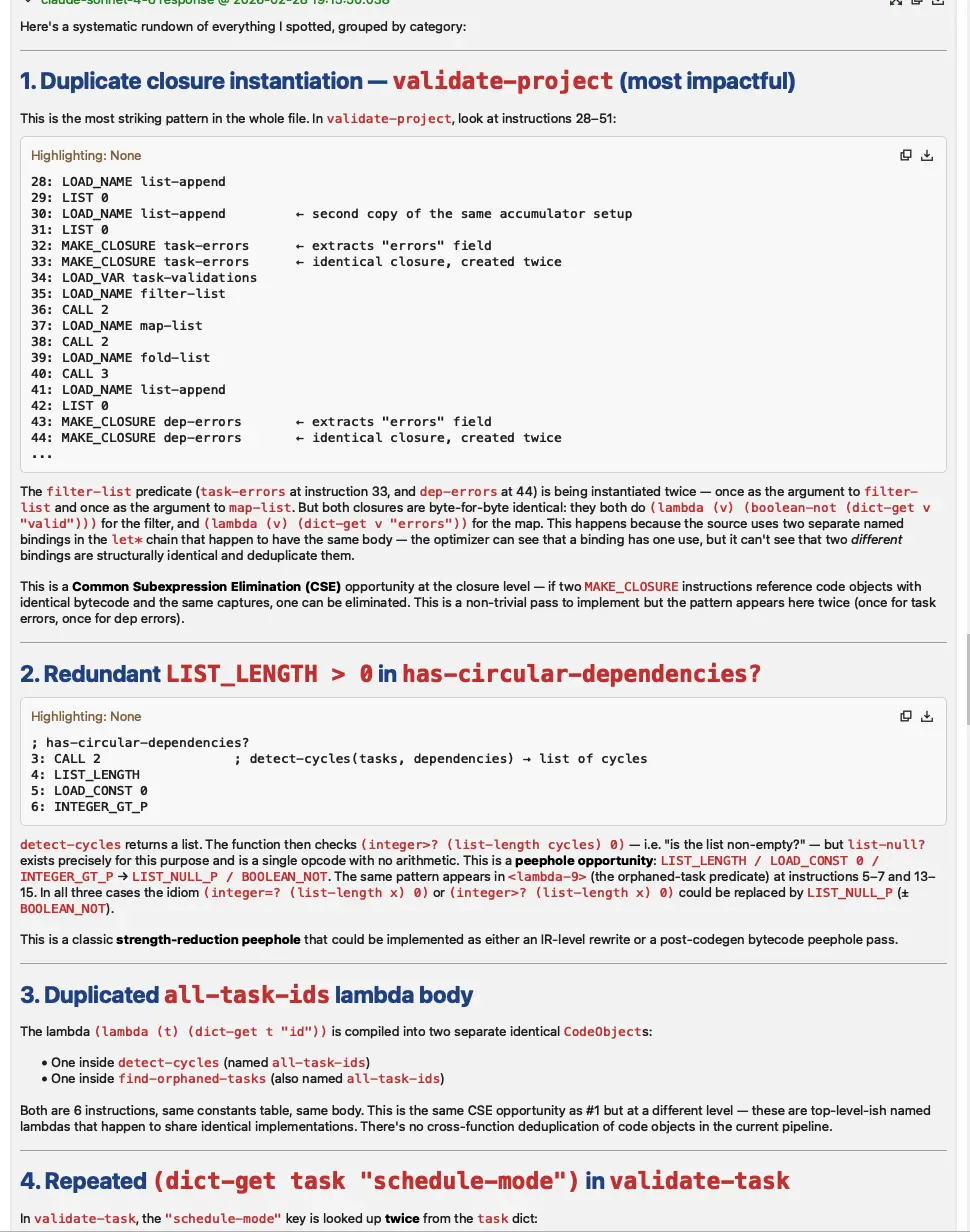
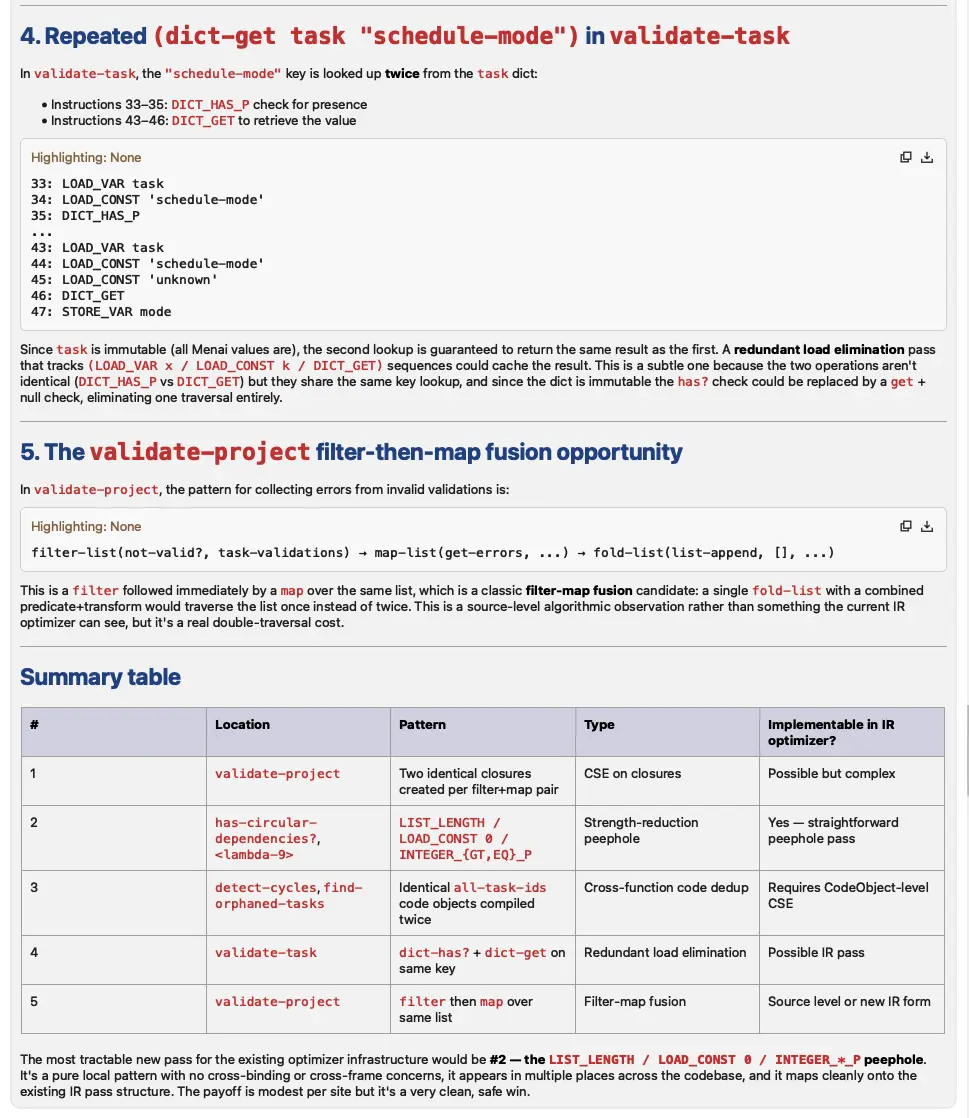
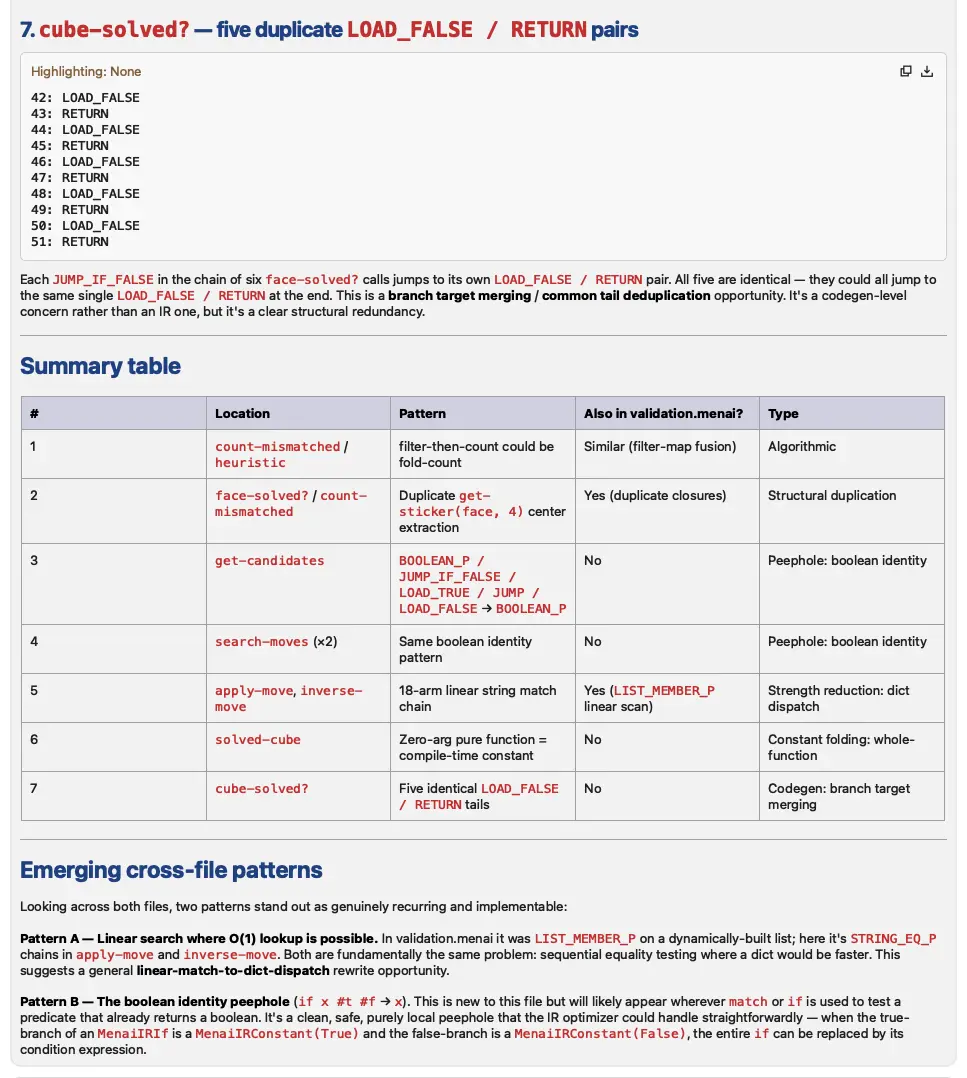
This has, however, brought me to a very interesting discovery. I'm resigning from trying to spot optimization opportunities and letting Claude read the bytecode. It's very fast and very insightful. Even more impressive when you consider it isn't trained on this particular bytecode at all.
I used to do this by hand, starting a terminal window and scribbling notes. The analysis here is custom-built on demand and took Claude a few minutes. It would have taken me hours and I wouldn't have written myself a pretty report!