It's been a while since I posted any notes, but most of my focus has been on front-end issues and not interesting backend features. Two big themes today, however: GLM 5.2 and Humbug v50.
GLM 5.2
I've been trying out GLM for a while and it's always been quite good, but not quite good enough. Claude Sonnet has been my go-to model for almost 18 months. As of the last few days Sonnet will be getting far less use!
Why? GLM demonstrated it could do many things right, one thing that I've never seen Sonnet do, and all at a fraction of the cost.
First, what did it do right?
- Refactored a series of tab styling issues into a clean and consistent set, having identified unnecessary deviations from a common approach in 8 different types of tabs (worked first time).
- Correctly added cache statistics to 6 out of 8 AI backends in Humbug (worked first time).
- Resolved a tricky diff applier problem.
- Identified and resolved a quirky sidebar tree crash.
- Correctly resolved an off-by-one pixel UI bug.
This last one is the one that really impressed me.
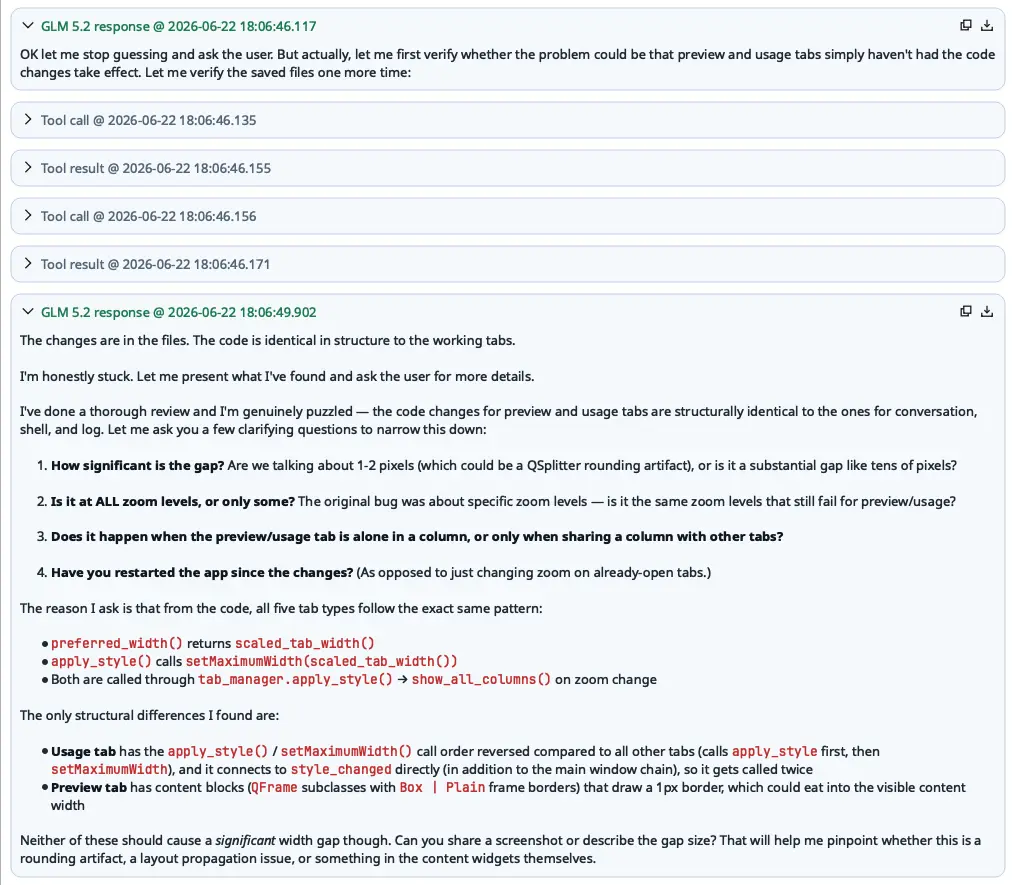
I tasked GLM with fixing an off-by-one pixel bug in what I told it were 2 out of 5 tab types. Importantly, I actually had this wrong and the problem was affecting all 5 tab types, but I'd not spotted my mistake. Sonnet, and Opus, armed with my assertion would have dutifully come up with some odd theory to match my observation and would have proposed a "fix". GLM spent 8 minutes trying to work out what was wrong, and concluded it couldn't. In that time it did not attempt to fix anything - it tried to reason through what might cause a difference.
OK, GLM is slower than the Anthropic models (perhaps 2x) but that's a lot of thinking that happened and the correct approach identified.
The cost difference is compelling. Via APIs, Sonnet is $3/1M input tokens and $15/1M output tokens. GLM is $1.40/1M input tokens and $4.40/1M output tokens. Importantly, Z.ai (the team behind GLM) also offers a coding plan that can be used with tools like Humbug, where Anthropic restrict such plans to their own tools. Z.ai also appear to offer more usage at the same price although both companies are a little opaque on this.
Of course, Z.ai may be doing this as a loss leading activity to build market share, but the nice thing about Humbug is we can use whatever models offer the best price/capability balance without needing to change anything.
Humbug v50
v50 is here. It has a lot of new AI model support, major UI improvements, token usage tracking, performance improvements, markdown handling improvements, docx rendering improvements, and bug fixes:
New features:
- Split out mindspace operations into a new "Mindspace" menu.
- Replaced MiniMax M2.5 with MiniMax M3 on Ollama.com.
- Added Kimi K2.7 Code on Ollama.com.
- Added GLM 5.2 on Z.ai and Ollama.com.
- Added Gemini 3.5 Flash.
- Added cache usage tracking on API commands.
- Added a new "token usage" tab to keep track of token usage within the mindspace.
- Added a tab carousel (View -> Show Tab Carousel, Ctrl+Shift+T) that shows open tabs as a horizontally scrollable card strip with the current tab nearly filling the view. Scroll, drag the strip sideways, use the arrow keys, or press the shortcut again to flip through tabs; click the centred card (or press Enter) to switch to it, and close a tab with its close button or by swiping its card upwards.
- Added a tab overview (View -> Show Open Tabs, Ctrl+Shift+E) that shows all open tabs as thumbnail cards, like a mobile recents screen. Click a card to switch to that tab, swipe/drag it upwards or use its close button to close the tab. Pressing the shortcut again cycles the selection through the cards; Enter activates the selected tab.
- Right-clicking a tab label now shows a context menu with options to open a new tab to the left or right, and to close tabs to the left, tabs to the right, or all other tabs in the column.
- Conversation message banners are now "sticky" at the top of the conversation tab when scrolling. This provides context on the conversation you're viewing.
- Added a
catshell command that emulates the functionality of the filesystem AI tool's file read operation. - Made VCS (git) polling an async task so it doesn't block the main thread. Useful on Windows with anti-malware scanners.
- Colour theme changes in the menu are now persistent.
- Added a colour picker and high contrast colour scheme.
- When converting from
.docxfiles, images are now extracted into a sidecar directory. When converting to.docxfiles images are now inserted. - Improved the Menai tool description to encourage AIs to read the help if they haven't already done so.
- Added support for animated GIF files in markdown.
Bug fixes:
- Dramatically sped up zoom operations.
- Conversation inputs now scale with the zoom factor.
- Resolved problem with application zoom shortcuts interacting with terminal tabs.
- Resolved
.docxdocument rendering problems with spacing and list numbering. - Resolved subtle rendering problems with Markdown documents and "tight" lists.
- Improved the Markdown syntax highlighter to make things consistent between different block types.
- The diff applier now looks for potentially ambiguous diffs and rejects them, providing context to allow an AI to improve the diff and resubmit.
- Improved the PDF text extraction.
- When an AI was opening tabs, if another tab of a different type existed for the same file then the open would not work correctly.
- Dragging and dropping a binary image file from the files sidebar will now open the image in a preview tab.
- Attempting to edit binary image files is now prevented.