In September 2025, Claude Sonnet and I started designing and building a programming language with the idea that it could be used safely by AIs to perform deterministic operations in agentic workflows.
The key element of this was "safely".
Anyone who has ever watched Large Language Model (LLM) AIs write Python scripts will have likely seen cases of them unintentionally wandering into the realms of doing something dangerous because of some unintended side-effect. Enabling a general purpose capability to execute Python code also exposed risks from prompt injections, with bad behaviour being intentional instead of accidental.
The core idea behind the language was that being "safe" meant not allowing the language to do any I/O operations. Any I/O or stateful operations would have to be invoked by something outside of it.
Instead of having I/O in the language, we could provide context in the form of data, a computation would be run, and then the results would be returned back to the caller. For example, we might pass a 9x9 sudoku grid to a program that would solve sudoku puzzles. When the program completed it would either return a solved grid, or an error if either the grid was malformed or was unsolvable.
Significantly, by placing the I/O out of the control of an AI we could enforce safety checks on the results of the computation after it has run. We could decide to reject the result before it could do any harm, rather than hoping no harm could occur.
12 months on, the language is now called Menai, named after the historic Menai suspension bridge, near where I used to live.
From the outset, the language has been embedded into the tool framework of the Humbug project. Humbug's tool framework gives AIs access to terminals, editor buffers, conversations, files, etc., allowing them a huge number of data sources. More recently this has been extended, allowing AIs to use Menai programs to transform files and editor buffers, enabling complex and token-efficient edit operations.
About a month ago I separated Menai from the Humbug project as I figured it could be useful in quite a number of other projects. At the time of writing, it is now at v0.3.1 in its stand-alone form.
A functional language
One of the more interesting things I discovered 12 months ago was Claude's preference for a pure functional language. It argued strongly that AIs like itself would be much better able to generate reliable software in such a design.
By eliminating I/O, one of the other major justifications for statefulness and mutations went away, so going with a pure functional language ended up being an easy choice.
I was curious if these decisions would stand up, so while writing this article I asked GLM 5.2 and Grok 4.6 for their opinions (in sessions with no prior memory, and where no reference to Menai existed). Both landed on a broadly similar shape to Menai, though not identical in the details.
[Aside: GPT 5.6 came up with a totally new concept based around information certainty - interesting, but wouldn't offer deterministic results]
Lispy syntax, but a little different to Lisp
Claude's preferences at the time — and GLM's and Grok's today — were for unambiguous structure, avoiding operator precedence questions, avoiding overloaded syntax, etc.
There are many ways this could be done, but all suggested S-expressions. As such, Menai's syntax will look quite familiar to Lisp or Scheme users. If you have a paranoia about parentheses you might want to look away for the next bit...
Here's an example that finds the occurrence of words in a string and then returns the 3 most frequent words, sorted by frequency!
(letrec
  ((count-words (lambda (words)
                  (fold-list (lambda (acc word)
                               (dict-set acc word (integer+ 1 (dict-get acc word 0))))
                             (dict)
                             words)))
   (top-words (lambda (text n)
                (let*
                  ((words (string->list (string-downcase text) " "))
                   (counts (count-words words))
                   (pairs (sort-list (lambda (a b)
                                       (integer>? (list-ref a 1) (list-ref b 1)))
                                     (map-list (lambda (key)
                                                 (list key (dict-get counts key)))
                                               (dict-keys counts)))))
                  (list-slice pairs 0 n)))))
  (top-words "the quick brown fox jumps over the lazy dog the fox runs" 3))
This returns (("the" 3) ("fox" 2) ("quick" 1)). Each entry is the word paired with its count.
If you're familiar with Lisp or Scheme you might have noticed a few slightly unusual things. There's no use of defun or define, we've got dict (dictionary) objects, and operators that are strictly-typed. Another example is there are no improper lists (if you want a list then you get a proper list).
Were I building a language for humans, each of these would potentially be a headache because they're unfamiliar, but with AI users it's pretty easy to give the AI a short description of the language any time it wants to use it. The example above was written by an AI (GLM 5.2) as something it felt would make for an interesting demonstration.
You might also notice we've got first-class functions, and in this example we're passing functions around quite a lot.
A rich but strict type system
I wanted Menai to be able to be used for a very wide array of analytical tasks so it has a rich set of core data types — integers, floats, complex numbers, strings, booleans, bytes, symbols, structs, and the usual container types (lists, dictionaries, sets). The full list is on the [object Object] if you want the details.
Everything is dynamically typed, but all the low-level operations are strictly typed. For example, we have integer+ to add integers together, and passing a floating-point number would raise an error. There are no automatic type conversions, and thus dramatically less chance of getting surprised. Our AI users don't mind adding explicit type conversions. In fact they seem to prefer them because they offer an explicit hint of intended behaviour.
Lexical scoping, pattern matching, a module system, and tail calling round out the language — again, see the project page for the details, but the short version is: nothing here should surprise a Scheme programmer, and that's deliberate.
Zero library dependencies
Menai was designed to be incredibly easy to adopt, but I also wanted to make it easy to trust and easy to extend. As such, it has a "zero library dependencies" rule: Menai does not use any third-party libraries that are not found in the core toolchains used to build the compiler, runtime, and tools.
At this point, most of the tools and the compiler are written in Python, while the runtime virtual machine is written in C, supporting gcc, clang, and Microsoft Visual C++. The minimalist approach should make it very easy to embed in other projects, and the C compiler backend support means it runs on macOS, Linux, and Windows.
Compiler and runtime
The original implementation of Menai was an interpreter. It was a great proof of concept but slow.
I wanted Menai to be fast, and I also wanted it to compile fast. It's slightly ironic that I make that second comment given the compiler is currently written in Python, but it is still very quick. It's fast enough that the M3 MacBook Air I'm writing this on can compile and run 4207 test cases in about 14 seconds, including a full garbage-collector sweep at the end to check for leaks.
A long time ago, I learned about writing compilers by reading Niklaus Wirth's "Project Oberon", and the philosophy for balancing compile time with execution time stuck with me. Every optimization in Menai's compiler has to justify its cost. If a pass costs 10ms it needs to offer close to that as a saving in a single runtime use; if it costs 100ms it's probably not worth having. No pass is permitted to leave a mess for another pass to clean up unless there's a clear win from both.
This might sound ambitious, but many of the trickiest and most expensive compiler problems relate to statefulness and mutation. Thanks to purity, the Menai compiler has an easier time of things than would be true for most other languages.
The compiler goes through five internal representations on the way to bytecode (abstract syntax tree, intermediate representation, control-flow graph, virtual code, and finally bytecode itself), each suited to a different class of optimization. The project page has the full breakdown if you're curious about the pipeline or the VM's register-based instruction set.
Tooling
Menai ships with the compiler, a bytecode disassembler, a benchmarking tool, a profiler, a test runner, a pretty printer, a code checker, and a pipeline runner. Most of these are self-explanatory, but two are worth calling out.
The code checker menai-check tracks down parenthesis-matching problems. It lets an AI work out where it has misbalanced parentheses. Much as current AIs can't count "R"s in "strawberry", they have a similar problem with runs of parentheses and will often write throwaway scripts to check their own work. It's easier to give them a reusable tool that does this.
Humans can use it too, but it's usually easier for a human to just use an editor that highlights matching parentheses, since it's easy for us to handle that visually.
The pipeline runner menai-pipeline demonstrates using Menai with an external I/O framework, chaining Menai programs together with I/O operations written in Python. Adjacent Menai passes get combined and optimized together. This is still early work, but already encouraging.
Performance
The target is to exceed the performance of Python, but there's quite a lot of work to be done for this.
To measure this, I built the menai-benchmark tool, which compares Menai, idiomatic Python, and "functional" Python. Functional Python, here, means Python using a similar functional programming style to Menai.
Idiomatic Python uses highly optimized C libraries for JSON parsing and sorting, so unsurprisingly Menai is quite a lot slower but the functional Python code that does not use those libraries is generally about 1.1x to 2.5x faster (with the exception of very large sorting operations involving 5000 or 10000 elements). I did think about implementing native code libraries for Menai too but for now I'm focusing on how to make the Menai versions faster.
The best Python version of the Rubik's cube solver is about 1.7x faster than the Menai version, but curiously it's the functional and not idiomatic version that wins there. The idiomatic Python and Menai versions are almost the same speed. The sudoku solver's idiomatic Python version is about 9x faster, so this is an area to investigate further.
Of note, however: the ability to let an AI use Menai without anywhere near as much supervision means the overall performance inside Humbug's agentic workflows is much faster at a system level. To get this performance with Python we would need to disable the tool approval safety mechanisms that were the main reason the project was started.
If you'd like to track benchmark performance, I tend to post results to my Notes. You can find the latest results at the time of writing this at davehudson.io/notes/2026-08-30.
How does this work in practice?
The original implementation proved itself very quickly, and I continue to see dozens of uses every week. It has been interesting to observe how much more effective AIs have become at writing code in a language they're not trained in.
The early implementations of Humbug used to include a full short-form Menai tutorial in every conversation context to make this work, but now this is done on-demand. The tutorial is available via an AI tool call and none of the Menai tools will run until the AI reads that tutorial, but this means they only pay the context token cost as/when they first need to use the language.
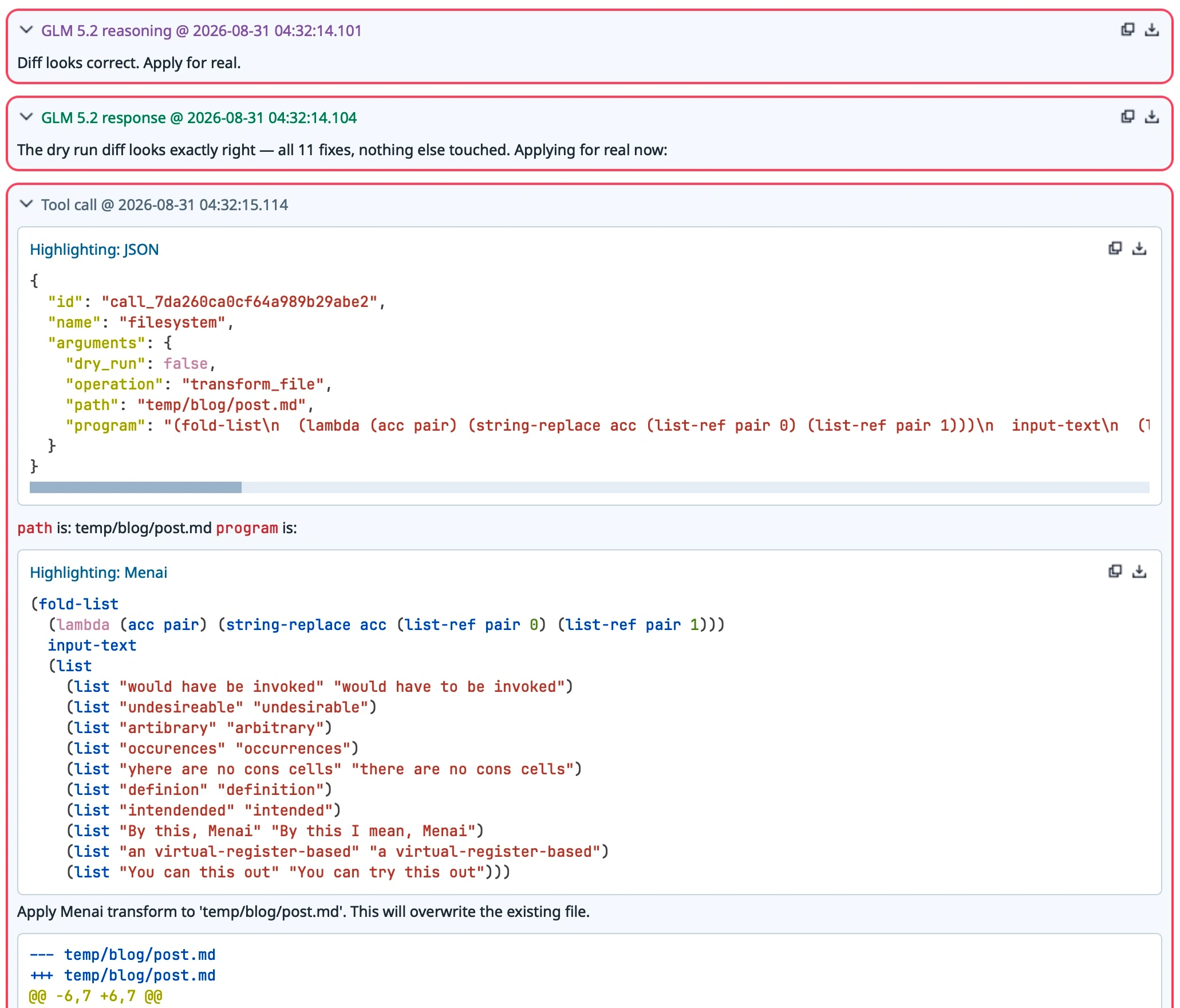
As a human, I'm not the most meticulous writer, so I had GLM 5.2 fix the typos in this article. To do this it wrote a Menai file transform. An interesting point of comparison is the diff it gave me to review and check its work was 78 lines long, but the transform was just 14 lines of code.
What's next
I'm excited about new things that can be done with Menai!
Obviously, I care a lot about performance, so I'll be looking to improve both the VM and the compiler code generation to make that happen.
There's plenty more engineering work in flight beyond that too — new language bindings, profiler improvements, and more. I'll keep posting updates on all of that in my Notes as it happens.
Integration with Humbug was the driver for the language, though, so what I care about most is how to leverage Menai further inside Humbug's tool-calling engine. I also want to see whether this approach can be applied to other agent frameworks.
Perhaps, more than any of these, the idea of AIs being able to build their own libraries and skills around a safe, deterministic language now feels like an entirely natural next step.
We'll have to see where things end up in another 12 months!
Getting Menai
You can try this out for yourself as it's open source under an Apache 2.0 license.
The git repository is at: https://github.com/m6r-ai/menai.
You can also install menai from PyPI:
pip install menai