This morning I asked an AI to tell me what was in a Microsoft Word document I wrote years ago. It wrote a program to do it, ran it, showed me the answer, and threw the program away. The whole exercise, including a follow-up question a little later, took just over a minute and cost less than $0.02.
I believe that's a sign that the economics of software have already changed, but it's also a major opportunity. Where, previously, software had to be designed for a mass market, we can now have software that's built for a few users, or even just one.
That comes with risk, and it only works if we can do it safely.
The world as-is
Let's start with hardware. The "hard" in hardware is because it's the part of our computational system that doesn't change quickly. It has been designed to enable algorithms to be executed at great speeds. Changes occur at the level of years, because it takes years to design and check it.
Now software. The "soft" in software comes from the idea that we can quickly define algorithms that can be applied to that very specialized hardware. We can modify it easily and quickly. In a single hardware lifecycle we could come up with thousands, or even millions, of different software designs for an instance of that hardware. In practice, however, the vast majority of the software we actually run doesn't change much either. Our software turns out to be surprisingly "hard".
Humans take a large amount of time to learn the nuances of problem domains. It doesn't matter if it's deeply technical or some business process area, they all have surprising complexity when you get into the details. Expertise is very expensive because we learn slowly. Experts design tools to help them but the economic cost of those tools is high because the people who built them are expensive. The tools don't have to be obvious software either. They might be spreadsheets, databases, even slide decks - all digital artefacts that cost a lot of time and money to produce.
The "soft" in software promised cheap, endlessly adaptable programs. Instead, software has become so expensive that we can only afford it if we can amortize the cost over very large numbers of users. We have ended up with a lot of "one size fits all" approaches.
What if those same costs dropped dramatically? Taken to an extreme, what if we could build things in a few tens of seconds? It would become practical to create software for just a single task. We could have an era of disposable, purpose-built software.
Enter the LLMs
A little under 2 years ago I started building an agentic AI framework Humbug. In late 2024, my then-radical idea was that 80%+ of the code should be written by LLMs. In under 2 years, 80% became pretty much 100%. Core to this was recognizing that LLMs can build software quickly, but struggle with understanding a project vision in much the same way as human developers. If I switched to a product definition and architectural oversight role I could get far more leverage.
As an example, when Anthropic or OpenAI add a new model I simply tell the current version of Humbug to go and read the website and update its own model specs. When OpenAI's new models would no longer work well using the Chat Completions REST endpoint, I had DeepSeek read the specs and sketch a plan for me to review, then write me a new implementation of the Responses endpoint instead.
I mention DeepSeek as it's the latest in a long line of different LLMs that have helped along the way (GPT-4o, Gemini, many iterations of Claude Sonnet, GLM 5.2 and 5.3, and now DeepSeek 4.1 Flash). Humbug is LLM agnostic (it can even switch LLM mid-conversation), and that means it has been able to use whichever model is most cost effective to achieve a result. Features now cost 10x less to build than a year ago, and are delivered at least twice as fast (based on assessments of API billing for LLMs early this year vs the ones now in use, and where billing is API usage based, not relying on coding plans).
Our limiting step used to be how fast we could glue things together, but LLMs can do that many orders of magnitude faster than a human.
Summoning a cheap feature
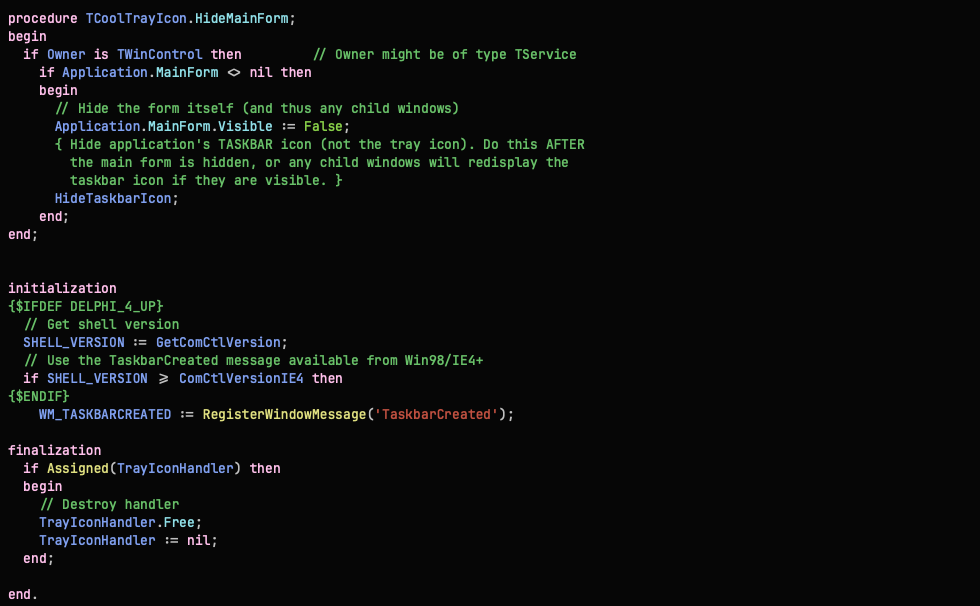
A few days ago, I was testing an idea related to the summoning of code. I was experimenting with an old zip file I had on my laptop. It turned out the zip file had a bunch of Pascal code in it as well as C++ so when DeepSeek unpacked the files it showed me a bunch of Pascal code.
Humbug didn't have a Pascal syntax highlighter (it has many others), but 17 minutes after I expressed the desire for one we had a new Pascal syntax highlighter, tests, and all system tests were green. DeepSeek asked for a few clarifications on matters of design taste, updated various related document files, and flagged an alphabetical ordering issue it had noticed (we fixed that too). It also (correctly) concluded that this change did not require it to write an architectural decision record (these are used by the LLM to track important architectural decisions). The total cost of the feature was under $0.20.
Is the syntax highlighter perfect? No. It can't work out types and highlight them, but it can handle reserved words, syntax structures, constants, comments, etc. Did it make it far quicker for me to understand what was in the zip file? Absolutely yes! Could I have built it myself for $0.20 - not even close.
Yes, I know I didn't count the few minutes of my time, my laptop's depreciation or a small amount of battery power, but I was doing other things at the same time too. I also know this was only possible because Humbug already made this kind of change straightforward. It falls under the heading of "LLM tooling made less expensive by effective LLM tooling".
In this instance I chose to make the syntax highlighter a persistent feature. In future, every other Humbug user can benefit from it. I had no idea I needed it until the need arose, but it was an obvious product capability once that need became apparent. The important part was I summoned this feature on demand.
All good stuff, but the zip file experiment behind this was more interesting. I'd asked the LLM to explore the contents and it decided to do so by using throwaway programs. That only makes sense if there's a safe way to run them, and that's where Menai comes in.
Composable software
One of the spin-offs from the Humbug project is a programming language Menai. Menai is a Lisp/Scheme-like language designed for LLMs to use. It only has pure functions (literally no I/O in the language and no state mutation), with any sources of data provided to it by a separate tool framework (in this case Humbug).
There are a few interesting ideas in Menai:
- The worst a Menai program can do is use too much time or memory, and Humbug enforces restrictions on both. There is a strict time limit on virtual machine (VM) program execution, and a limit on the amount of heap space that can be used.
- It can only work on the data provided to it by the tool framework (Humbug in this case), so if Humbug doesn't let you read your
.sshdirectory or the file with your API keys then the LLM can't write a program that will fetch them. - It throws away any library code it doesn't need (whole program optimization) allowing it to be fast to compile and run.
- Using pure functions makes it very easy for an LLM to compose functions on top of each other.
- It has a standard library of modules written by LLMs that can be composed on demand. The libraries are in source form so the LLM gets to read the code to understand how they work and how to use them. They're "discoverable".
Library modules are defined in the spirit of the Unix philosophy. Each provides small chunks of orthogonal functionality that can be freely composed to solve a more complex problem defined by an LLM. Give a capable LLM a problem, it can find the library components that can help and then craft a custom program to help achieve the user's request. If it can't find a component it needs then it's also free to write new ones, including tests.
The user experience is to express a desired outcome, the LLM works out how to solve it deterministically, then processes the results until it's ready to present them back to the user.
The actions are auditable. Each operation and each deterministic program execution is captured in the AI conversation transcripts.
A worked example
Back to my experiment this morning...
Many years ago I used to work in procurement and wrote a spec for a long-obsolete PC. I have a version of the spec as a Microsoft Word docx file. I asked DeepSeek to read the spec and tell me what the document was about (and asked it not to cheat by using the pre-existing read_text tool).
The speed with which it acquired the skill to do this may remind you of Trinity asking for a program to fly a B212 helicopter in the Matrix...
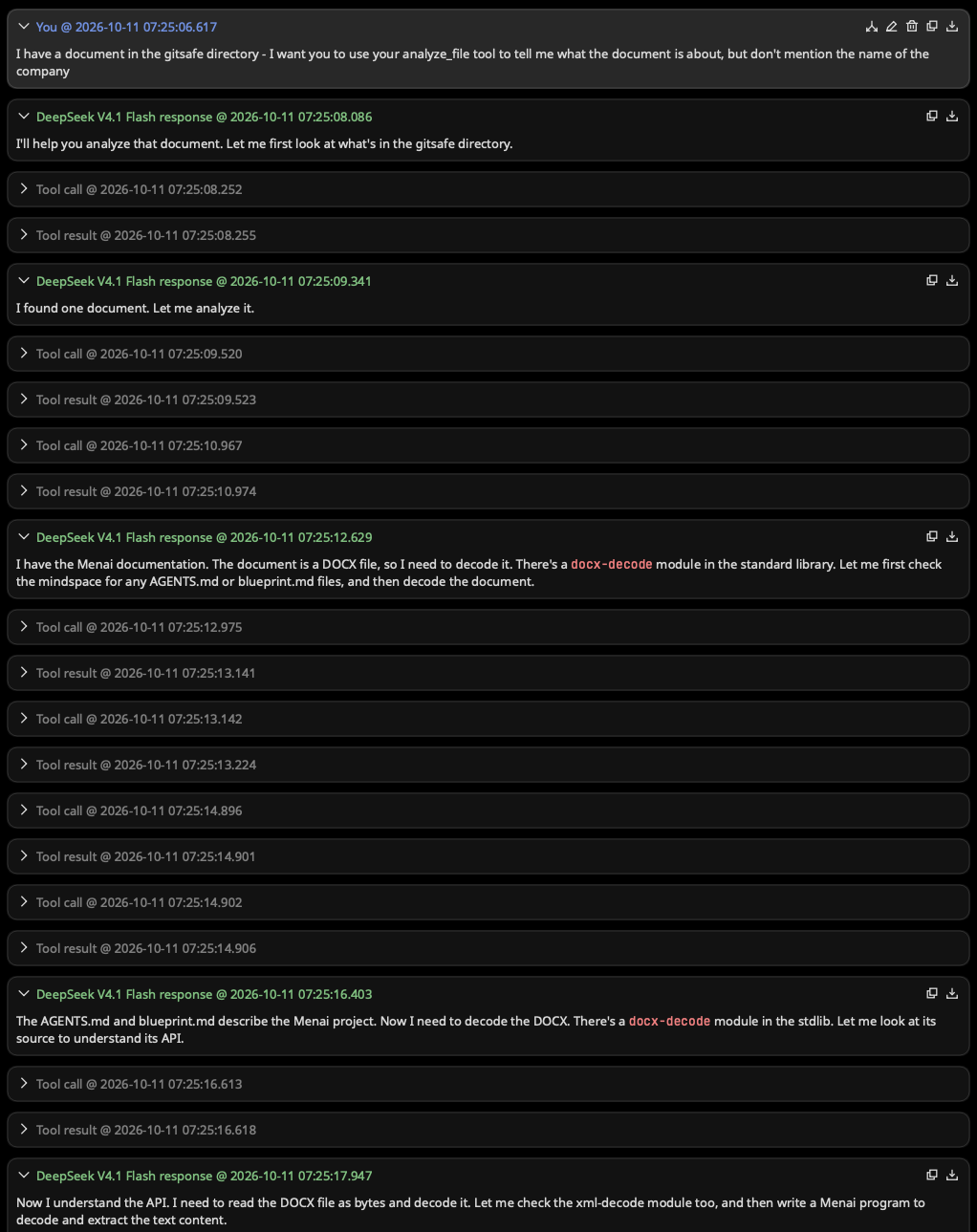
In 9 seconds, DeepSeek found the file I requested, read the Menai help file (to understand the language because it doesn't know anything about it when it started), found and read the project blueprint.md file, found and read the AGENTS.md that goes with it, and read the implementation of the docx-decode.menai library file.
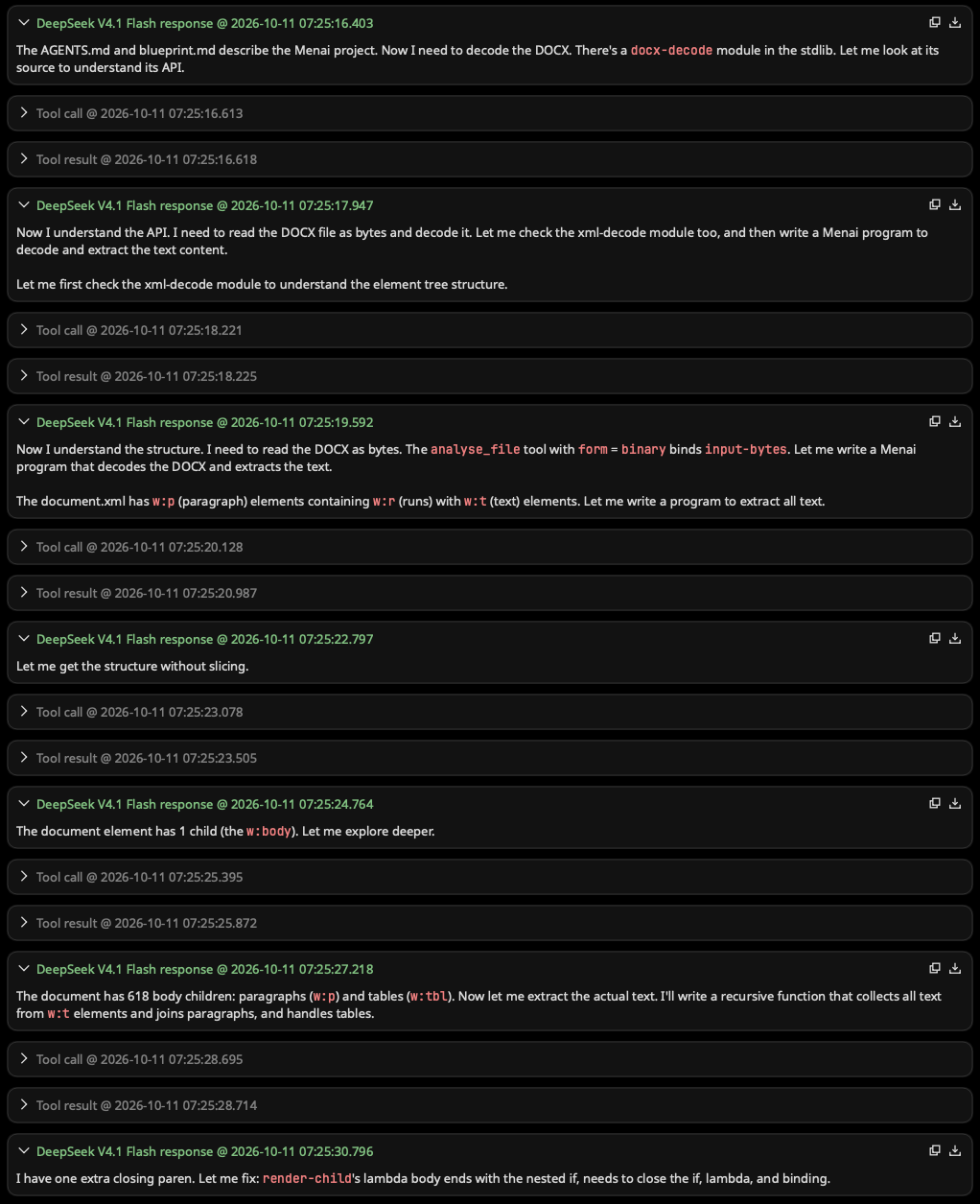
Another 14 seconds, and DeepSeek had started to write code to pull apart the docx file (for anyone unfamiliar, the main file in a docx file is an XML file inside a zip file). It now knew there were 618 elements within it.
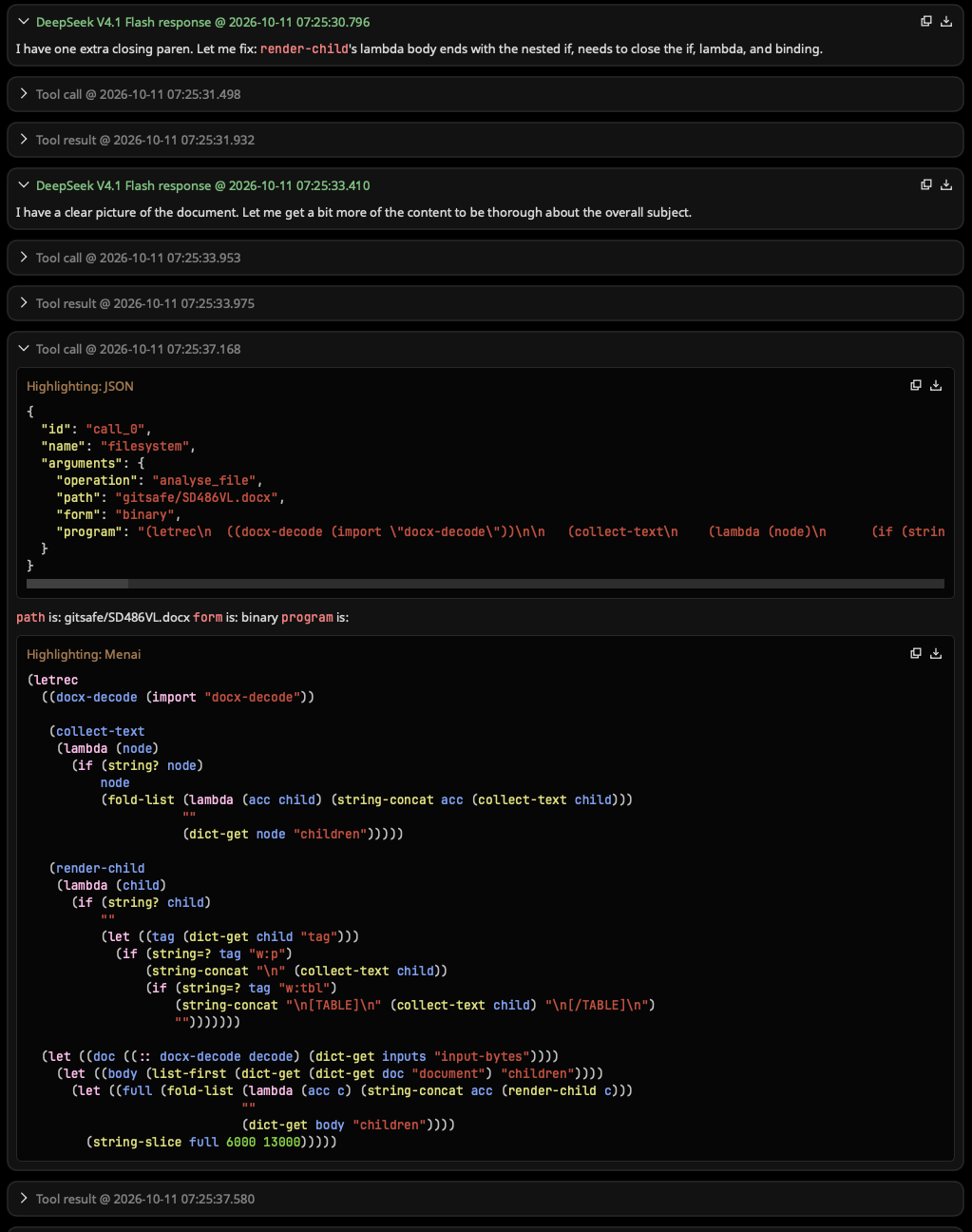
DeepSeek had now fixed a syntax error (LLMs can struggle with paren nesting in s-expressions sometimes, but the Menai compiler does a lot of work to help them pinpoint and resolve issues), and we had the program that was summoned to answer my question.
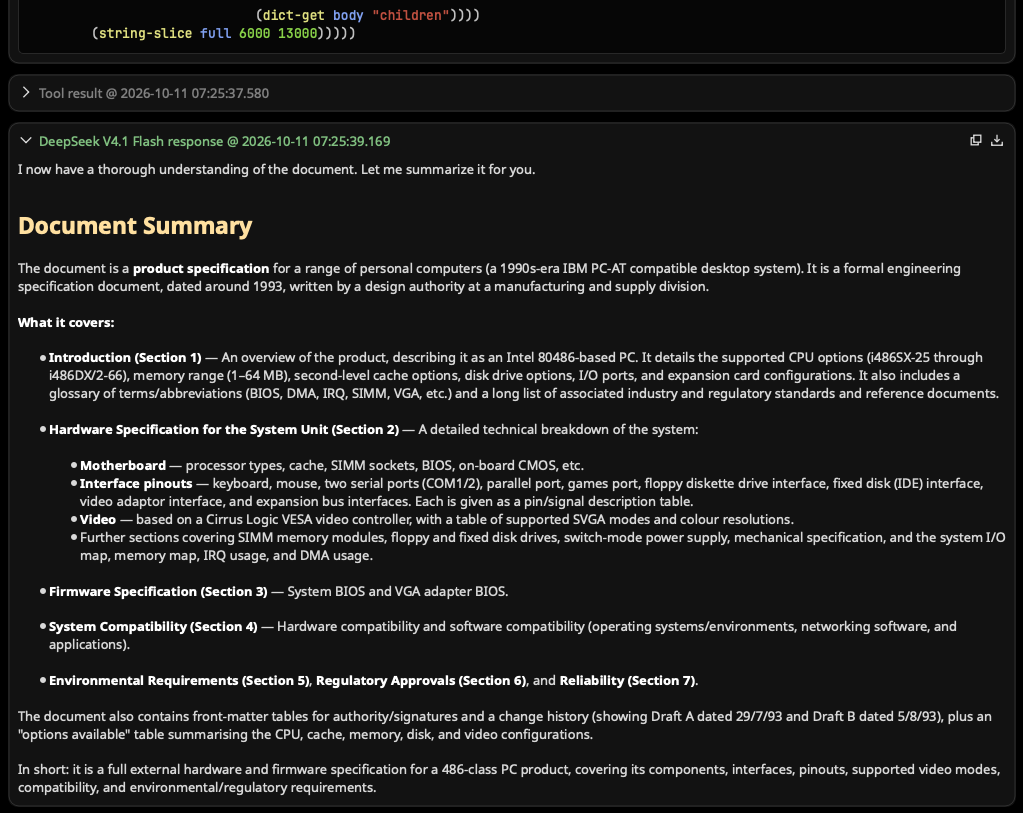
At 33 seconds, from start to finish, we had a description of the document contents.
Things got more interesting with a follow-on prompt: "can you give me all the section headings and how long each section is".
This added another 34 seconds of work, and resulted in a total cost for all the work of less than $0.02 (it might be less than $0.01 but there's some rounding on the billing report).
The read_text tool's built-in docx converter would have handled the initial query faster, but it couldn't handle this one. At best our LLM would either try to guess or resort to writing a Python script.
You can see the full, disposable, 106-line program in the postscript section. It existed for long enough to meet my objective for this blog post and then had no further purpose. It's a demonstration of something that cost next to nothing to build and thus could be discarded.
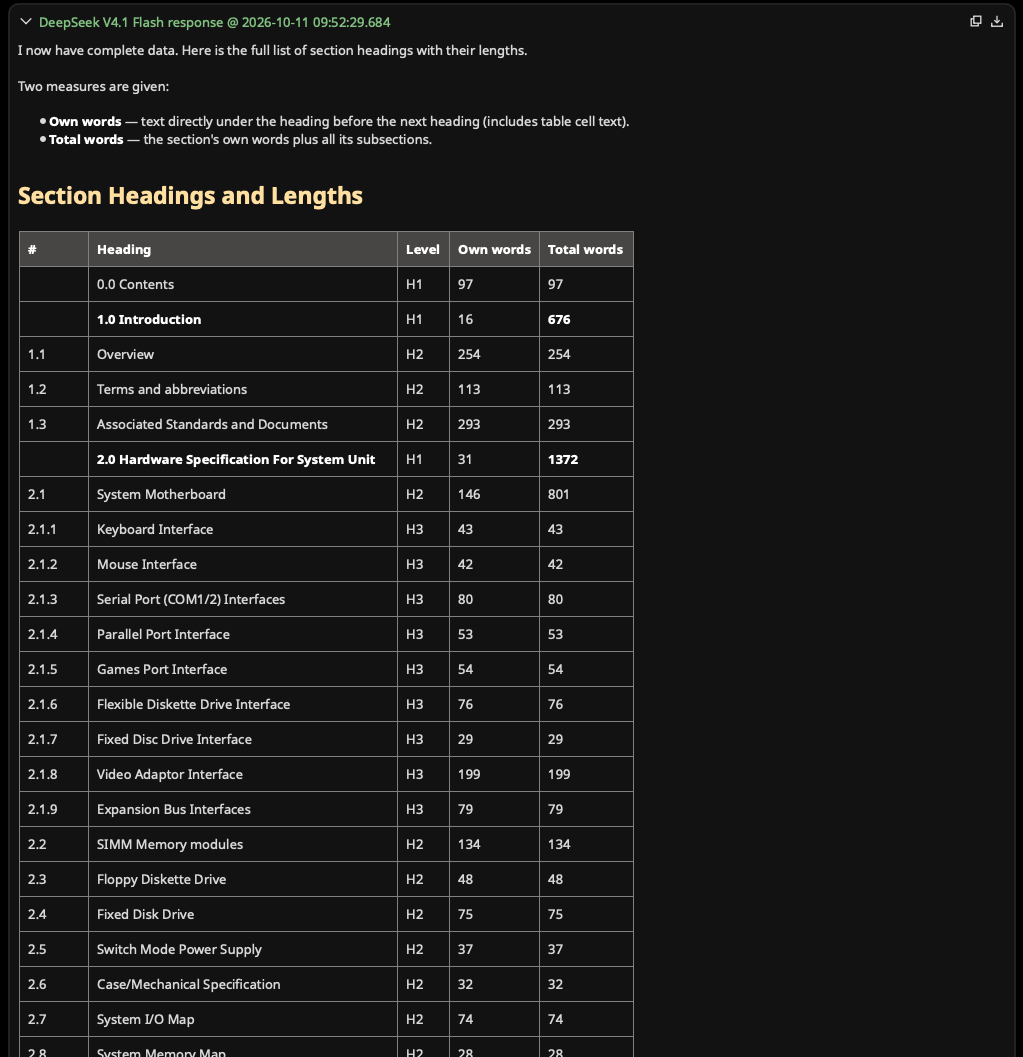
I didn't exhaustively check the results, but I couldn't find any mistakes after I manually sampled sections at random. Word counts were correct and matched my own. It was certainly enough to give me the sort of qualitative assessment I was looking for on relative sizing.
One important thing to note is that this approach substantially reduced the risk to the machine running the programs.
None of the steps in our example required authorization because a Menai program has nothing that needs it. It has no ambient authority bestowed by the user's permissions. This matters. If approvals are rare then users are much more likely to pay close attention to them and are far less likely to fall into authorization fatigue and keep clicking "approve".
Were such tools written in Python code I'd have to carefully review every script to ensure safety, or else put the Python interpreter in a container and orchestrate interactions between the LLM and that sandbox.
A few last thoughts
I don't claim Menai and Humbug are the answer to all the problems I've described, but they do help explore some potential solutions. LLMs offer us an interesting challenge, so it's time to find some new approaches.
Here's what I think we should start with:
- Generated programs should have no ambient authority. Data can only be passed from or to the AI tooling harness.
- A pure language is much safer to work with, and we don't lose any computational power. We can still process complex binary data, as the docx example showed.
- Strong audit trails are important. We can see what was requested and why. We can also check for bugs in summoned programs later, should we have concerns.
- We should make approvals infrequent by design. They should signify a genuine need for caution.
Summoning software on demand seems inevitable. Doing it safely is not, but it should be. We should be designing for it now. If we get that right then we should be looking forward to an era in which software can be personalized in ways that used to look like pure science fiction.
Postscript
The throwaway program written to calculate the section details and sizing is here. This is extracted, unedited, from the tool call that was made.
(letrec
  ((docx-decode (import "docx-decode"))

   (collect-text
    (lambda (node)
      (if (string? node)
          node
          (fold-list (lambda (acc child) (string-concat acc (collect-text child)))
                     ""
                     (dict-get node "children")))))

   (para-style
    (lambda (p)
      (let ((ppr (find-list (lambda (c) (and (dict? c) (string=? (dict-get c "tag") "w:pPr")))
                            (dict-get p "children"))))
        (if (dict? ppr)
            (let ((s (find-list (lambda (c) (and (dict? c) (string=? (dict-get c "tag") "w:pStyle")))
                                (dict-get ppr "children"))))
              (if (dict? s) (dict-get (dict-get s "attrs") "w:val") "none"))
            "none"))))

   (level-num
    (lambda (style)
      (match style
        ("Heading1" 1)
        ("Heading2" 2)
        ("Heading3" 3)
        ("Heading4" 4)
        (_ 0))))

   (is-heading?
    (lambda (p)
      (integer>? (level-num (para-style p)) 0)))

   (word-count
    (lambda (s)
      (list-length
        (filter-list (lambda (w) (string!=? w ""))
                     (string->list s " ")))))

   (child-text
    (lambda (c) (if (dict? c) (collect-text c) "")))

   (walk
    (lambda (children state)
      (if (list-null? children)
          (let ((heading (list-nth state 0)))
            (if (string=? heading "")
                (list-nth state 4)
                (list-append (list-nth state 4)
                             (dict "heading" heading
                                   "level" (list-nth state 1)
                                   "words" (list-nth state 2)
                                   "paras" (list-nth state 3)))))
          (let ((c (list-first children)))
            (let ((heading (list-nth state 0))
                  (style (list-nth state 1))
                  (wc (list-nth state 2))
                  (pc (list-nth state 3))
                  (secs (list-nth state 4)))
              (if (and (dict? c)
                       (string=? (dict-get c "tag") "w:p")
                       (is-heading? c))
                  (let ((newsecs (if (string=? heading "")
                                     secs
                                     (list-append secs (dict "heading" heading
                                                             "level" style
                                                             "words" wc
                                                             "paras" pc)))))
                    (walk (list-rest children)
                          (list (string-trim (collect-text c))
                                (para-style c)
                                0
                                0
                                newsecs)))
                  (walk (list-rest children)
                        (list heading style
                              (integer+ wc (word-count (child-text c)))
                              (integer+ pc 1)
                              secs))))))))

   (inclusive-words
    (lambda (secs idx)
      (let ((level (level-num (dict-get (list-nth secs idx) "level"))))
        (letrec ((loop (lambda (j acc)
                         (if (integer>=? j (list-length secs))
                             acc
                             (let ((l (level-num (dict-get (list-nth secs j) "level"))))
                               (if (integer<=? l level)
                                   acc
                                   (loop (integer+ j 1) (integer+ acc (dict-get (list-nth secs j) "words")))))))))
          (integer+ (dict-get (list-nth secs idx) "words") (loop (integer+ idx 1) 0)))))))

  (let ((doc ((:: docx-decode decode) (dict-get inputs "input-bytes"))))
    (let ((body (list-first (dict-get (dict-get doc "document") "children"))))
      (let ((secs (walk (dict-get body "children") (list "" "" 0 0 (list)))))
        (map-list
          (lambda (pair)
            (let ((idx (list-first pair))
                  (s (list-nth pair 1)))
              (dict "heading" (dict-get s "heading")
                    "level" (dict-get s "level")
                    "own-words" (dict-get s "words")
                    "own-paras" (dict-get s "paras")
                    "incl-words" (inclusive-words secs idx))))
          (list-zip (range 0 (list-length secs)) secs))))))